
Big Crops, Bigger Competition
Grain futures softened as U.S. harvest progress and strong crop ratings signaled ample supply. Brazil’s exports and Russia’s offers undercut prices, while weak sales and modest ethanol/crush support capped rallies.
Wheat
December Wheat surpasses $530/bushel, but remains below $550 mark

- U.S. harvest momentum kept nearby supply comfortable. Winter wheat was essentially wrapped up, and spring‐wheat cutting accelerated, with conditions broadly steady, limiting carry in December spreads despite scattered quality chatter.
- Export interest improved, but competition stayed fierce. Weekly FAS data showed a solid uptick in new-crop sales, and U.S. Wheat Associates noted commitments running ahead of last year, yet pricing power was tempered by rival origins.
- Europe siphoned demand amid mixed quality. FranceAgriMer/AHDB reported lower protein but acceptable milling metrics, while Egypt’s state buyer booked sizable French volumes via private deals, redirecting near-term demand away from U.S. classes.
- Black Sea dynamics and security risks capped rallies. Russia kept its wheat export duty at zero while 12.5% bids softened and August export pace remained subdued; meanwhile, drone strikes in the Odesa region rekindled corridor-risk headlines without a lasting premium.
Corn
Corn futures touch $4.2 mark, as demand for Ethanol strengthens
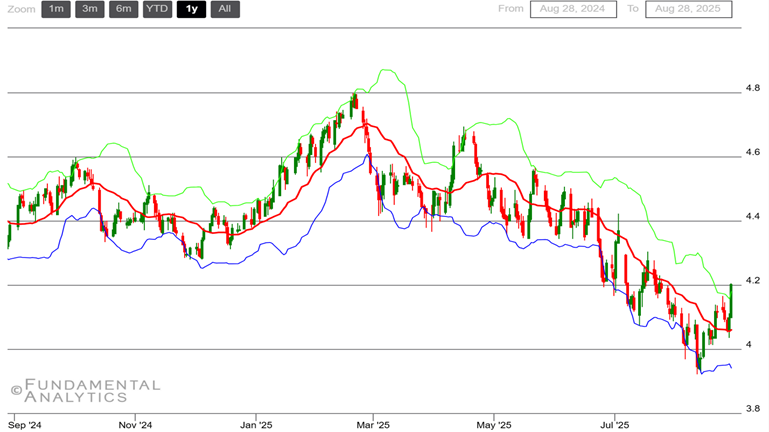
- Benign U.S. crop signals kept supply heavy. Late-August Crop Progress held corn near ~71% good/excellent with pollination largely wrapped, reinforcing trend-line yield expectations and limiting weather-risk premia for December futures.
- Old-crop sales slipped while forward bookings rose—but rivals undercut. USDA logged net reductions of 17.8 kt for current-year corn and ~2.09 MMT in new-crop sales; meanwhile, ANEC projected ~7.8–8.0 MMT of Brazil corn exports in August, pressuring U.S. offers.
- Ethanol demand offered only modest support. EIA-tracked fuel-ethanol output eased around 1.07 mb/d mid-August and stocks were little changed—signs of steady but unspectacular domestic offtake into the year’s peak driving window.
- Policy shifts reshaped trade flows at the margin. The EU’s reinstated tariff-rate quotas sharply curbed duty-free Ukrainian maize, while Mexico’s USMCA-compliant stance on GM-corn imports reduced a prior tail-risk—netting to neutral for CBOT as Brazil’s competitiveness dominates.
Soybeans
November contracts stabilize around $10.5 mark
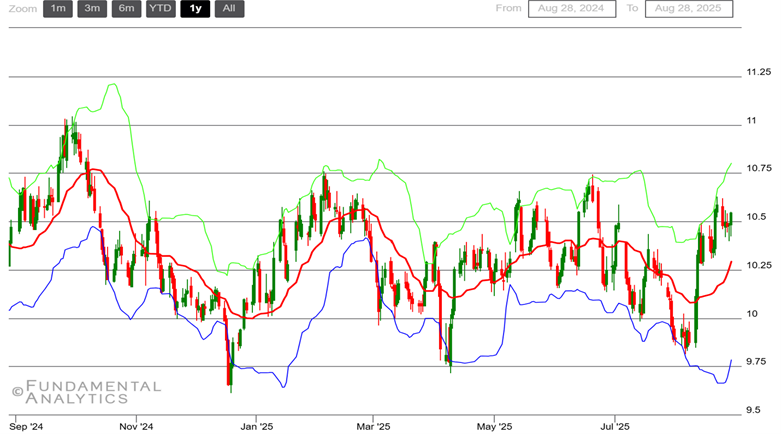
- Field conditions limited weather risk premia. USDA reports kept U.S. soybeans near ~69% good/excellent into late August, with pod-setting advancing, reinforcing a broadly comfortable new-crop supply backdrop for November futures.
- Old-crop export sales faded into year-end. Weekly FAS data showed very light net soybean sales late in the marketing year, and new-crop bookings remained modest—insufficient to spark board strength.
- South America tightened the vice on U.S. offers. Brazil’s August loadings were projected near 8.5–9.1 MMT, while Argentina’s export-tax cuts and China’s diversification toward Argentina/Uruguay sharpened price competition and siphoned demand from the U.S. Gulf.
- Record domestic crush offered only partial support. NOPA’s July crush at ~195.7 mbu (record for the month) underpinned meal/oil demand, but robust global supplies and soft export flow capped November CBOT rallies.