Harvest Glut vs. Heatwave

Grain futures softened overall as ample Northern Hemisphere harvests, USDA acreage shifts, heat-induced yield risks, and uneven export demand—tempered by logistical hiccups—kept markets range-bound ahead of July holidays, denting trade.

Wheat

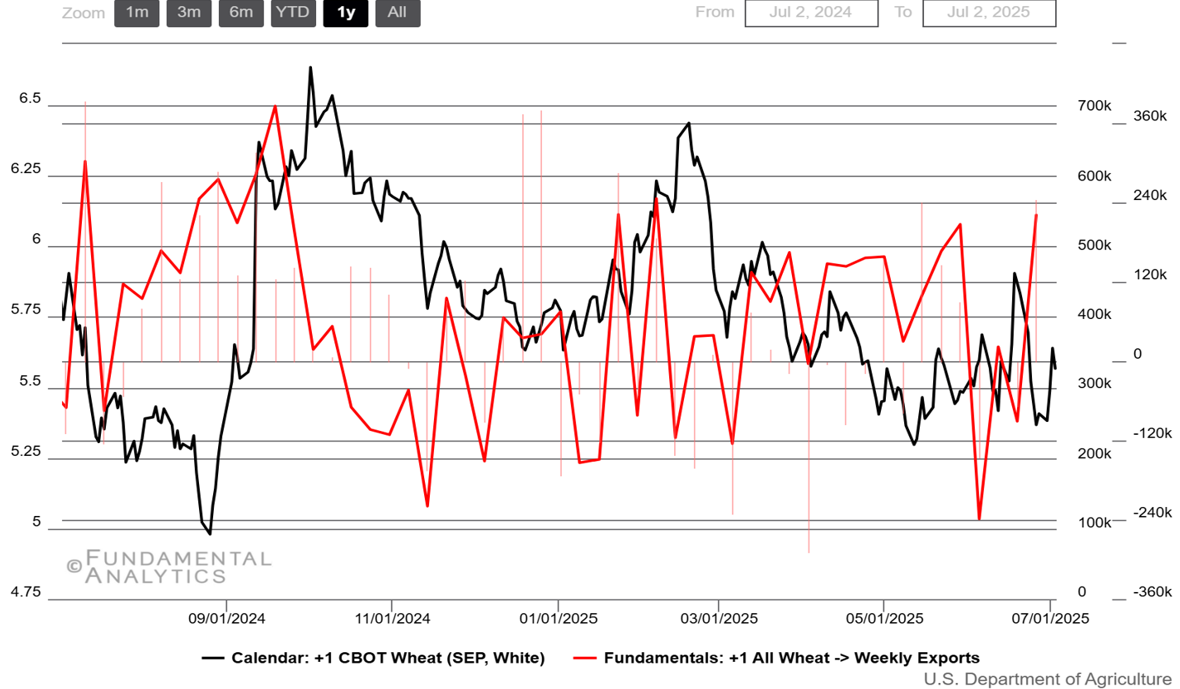
Wheat prices near two-week high, driven by advancing US winter harvests

  • Domestic acreage trimmed, but harvest lags while quality holds. USDA’s late-June Acreage survey cut all-wheat seedings to 45.5 M acres (-1% y/y). Crop-progress updates show winter-wheat cutting trailing the five-year pace, yet good/excellent ratings near multi-year highs, leaving overall U.S. supply prospects comfortable but not burdensome.
  • Early new-crop export sales encouraging, yet price competitiveness lacking. U.S. exporters booked about 586 kt of 2025/26 wheat in the week reviewed—the best early-season tally in a decade—but Chicago spreads softened as buyers continued to favor lower-priced Black Sea offers.
  • Black Sea pressure intensified. SovEcon (a leading consultancy) nudged Russia’s 2025 harvest outlook to 83 MMT, and Moscow confirmed the wheat export duty will drop to zero in July, signaling an aggressive export push that kept CBOT rallies in check.
  • EU-Ukraine trade realignment adds demand-side uncertainty. Brussels reinstated—and then adjusted upward—tariff quotas on Ukrainian wheat, reshaping intra-EU flows while potentially redirecting some Black Sea shipments toward North Africa and Asia, further complicating the global balance sheet.
Corn

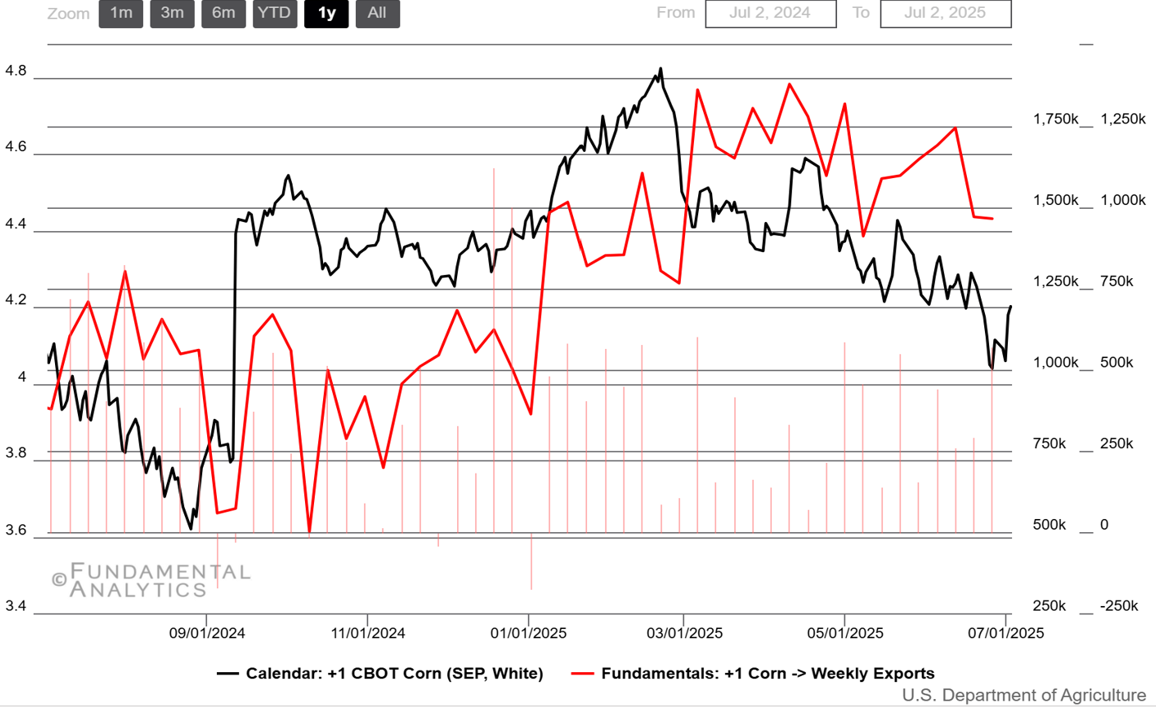
Corn futures climbed above the $4.20 mark, recovering from six-month lows as tightening supplies converged with resilient demand

  • Bearish supply backdrop intensifies. USDA’s Acreage survey put 2025 U.S. corn seedings at 95.2 M acres (+5% y/y), while June 1 stocks were still a hefty 4.64 bn bushels even after a 7% drop from last year; 69% of the crop is rated good/excellent—well above average—reinforcing confidence in ample new-crop availability.
  • Export pulse slowed amid stiff Brazilian competition. Net old-crop sales of just 532.7 kt for the week ended June 26 were 28% below the prior week, and traders note FOB Santos corn from Brazil’s record safrinha harvest continues to undercut U.S. Gulf offers, limiting additional bookings.
  • Domestic grind lost momentum. EIA reported a second straight weekly dip in ethanol output to 1.081 mbbl/day with inventories edging up to 24.4 mbbl, signaling softer feed-corn disappearance at precisely the moment supplies are swelling.
  • Geopolitics and sentiment add headwinds. The EU’s newly reinstated quota caps just 1 MMT of duty-free Ukrainian corn, reshuffling Black Sea flows, while money-manager net shorts ballooned to -184,788 contracts—mirroring last year’s ultra-bearish stance and amplifying downside pressure on CBOT futures.
Soybeans

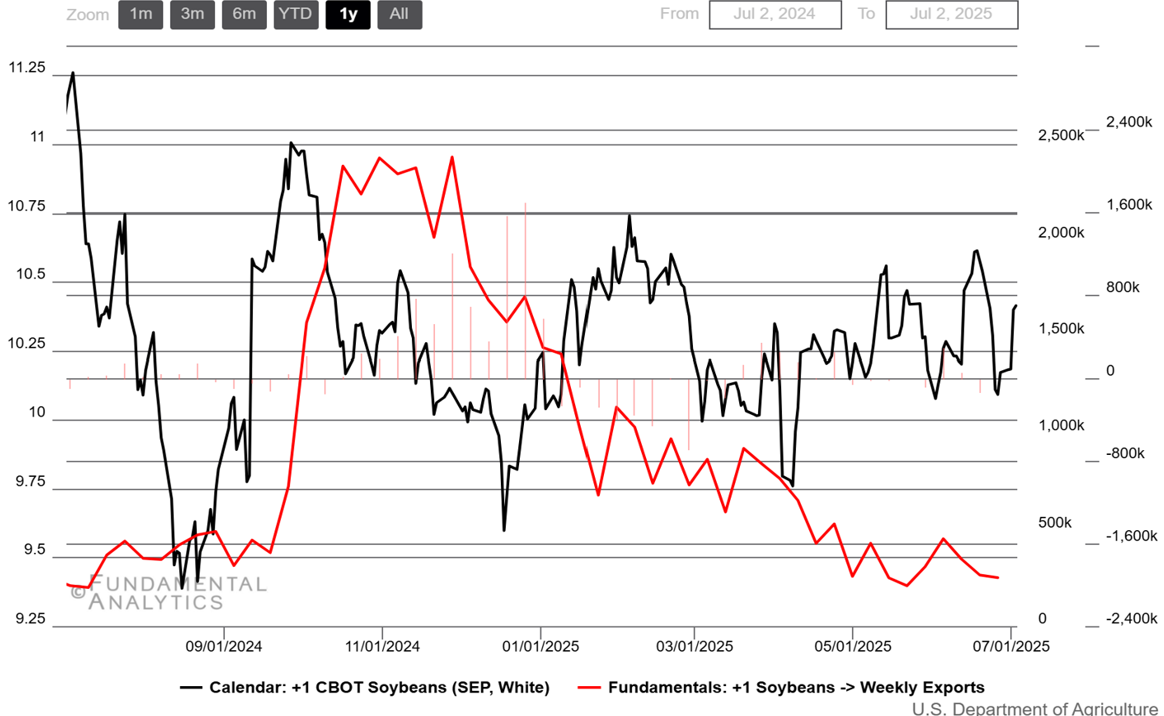
Soybeans gained 2.2% w/w, supported by short covering and pre-holiday positioning

  • Acreage dip offset by swollen inventories. USDA’s June Acreage update trimmed U.S. soybean plantings to ≈83.4 M acres (-4% y/y), yet the Quarterly Stocks report showed June 1 carry-in at 1.008 billion bushels—the largest early-summer inventory since 2020—leaving the overall supply base comfortably sized despite lower seeded area.
  • Field conditions steady, weather premium muted. Crop-progress data kept nationwide good/excellent ratings near 66%, and mid-Corn Belt heat largely aided growth; scattered storm damage and talk of late-July dryness failed to generate sustained buying as the crop still looks mostly healthy.
  • Export pulse improved but China stayed sidelined. Net sales of 462 kt for the week to June 26 marked the best tally in two months, led by Egypt and “unknown” destinations. However, Beijing’s ongoing drive to cut soymeal inclusion continues to cap Chinese appetite, tempering the demand boost.
  • Brazilian surplus undercuts Chicago. CONAB nudged its crop estimate to a record ~196 MMT while shippers lined up nearly 15 MMT of June loadings, keeping FOB Paranaguá well below U.S. Gulf offers and weighing on CBOT soybean spreads.