
Dr. Ken Rietz
Weather is arguably the most important uncontrollable aspect of agriculture. Appropriate amounts of rain need to occur at specific stages of plant growth. Either too much or not enough rain can doom a crop. The heavy rains in parts of the Midwest during May through July of this year require a closer evaluation of the corn crop, and it doesn’t look very good there right now. We will investigate this in today’s commentary. But first, we need to see where we stand. Here are the current front month futures contract prices from CBOT.
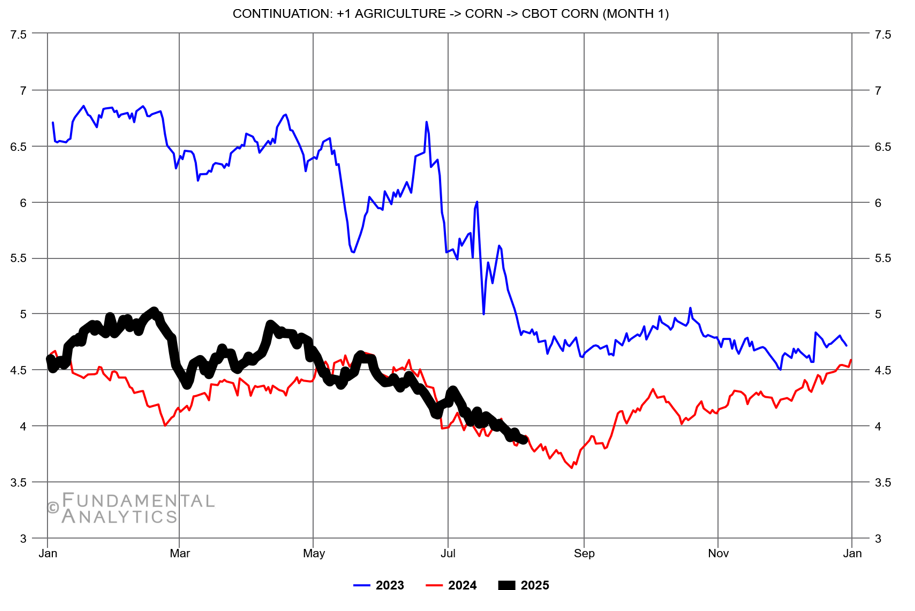
Figure 1: CBOT front-month corn futures
Note that the trend is clearly downward, an indication that the market sees an abundant corn harvest rather than a diminished corn crop, at least right now. We will come back to this at the end of the commentary.
Some of the reports of heavy rains are quite spectacular. In Missouri, one region got nearly double the usual amount of rain through July, roughly equal to the average annual rain total. As you can imagine, this produced a lot of flooding around the crop. At the wrong time, even three to four consecutive days of high moisture from rain or heavy fog has battered parts of Illinois, Iowa, Minnesota and South Dakota, and interrupted a crucial stage of pollination. The degree to which this will destroy a portion of that crop is as yet unclear.
When corn crops are under water, a host of problems can occur, depending on the length of time the plants are submerged. A disease called crazy top is very likely, as well as stalk rot, root rot, and other problems can occur. The effects can range from diminished yields to total loss. Cornhoppers prefer wet crops, and complicate matters further. Flooding on the Mississippi River might reduce that corn crop by an amount a half million acres to a full million acres.
Given this variety of problems, you might think it odd that the futures market for corn hasn’t been going up due to a reduction in supply. There are some reasons for its behavior, though, which I summarize here. Here is the graph of the front-month futures over the past 10 years (omitting the four years when COVID was causing all patterns to go haywire).
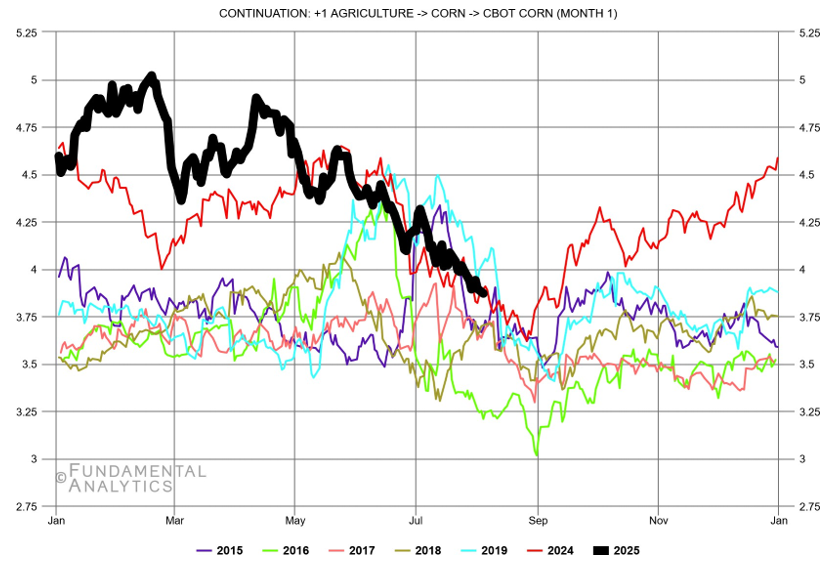
Figure 2: CBOT front-month corn futures
Note that a general downtrend is typical at this time of the year. Also, soybeans, often grown in the same regions as corn, are being similarly affected, but soybeans are more naturally resistant to over watering, so the problem is not as severe for them. There are 40 to 60 days until corn harvest begins, and the degree of recovery of the corn crop is not well known yet, so the futures market is waiting until more definite information is available, such as the USDA evaluations of the corn crop. Plus, there are large areas of the Corn Belt that haven’t been seriously affected, and those crops are doing well with the extra rain.
What is a trader to do with this jumble of information? The market is always right, so prudent traders will follow it down, but beware that some upswing is not just possible, but fairly likely, as the effects of the deluge emerge.