
Dr. Ken Rietz
A top priority for China is food security, which makes rice a top commodity. China has an aggressive program of genetic modifications (GM) to rice, with varying degrees of success. Lately, they have engineered a variety of rice that is amazingly useful. The growing conditions of rice have some narrow requirements; lots of water, a neutral to slightly acidic soil, no salt in the soil, and mildly hot weather. The new GM variety of rice thrives without those requirements. Specifically, the rice can grow in extreme heat that would debilitating to normal rice. We look at this variety in today’s commentary. First, here is the graph of the major producers of rice in 2022/23.
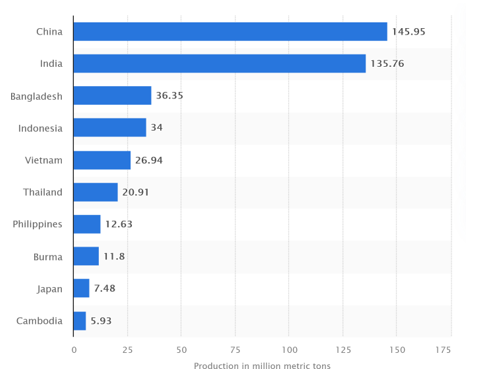
Figure 1: Rice grown by country, 2022/23. Source: Statista
Many people are immediately skeptical of news that comes from China. In this case, however, there is independent verification of the claims. It probably is not sufficient that the China Academy of Science and several high-profile Chinese universities support the claims, since they are all tightly coordinating with the Chinese Communist Party. However, there is a highly-respected, international, peer-reviewed journal, Cell, that has an article on this variety of rice, and supports the assertion that it is highly resistant to extreme temperatures. The genetic modifications change a hormone in the plant that will respond to the environmental stressor, like extreme heat. The activated hormone creates a shield for each cell, allowing it to survive the stressor. This is exactly the stressor that the journal article verifies, but that also makes it plausible that the modified hormone can counteract the other stressors as well.
The assertions are quite impressive. The Chinese have planted this rice in the upper Yangtse valley, known specifically for its high temperatures and wet environment. The modified rice was able to outproduce standard rice by about 78%. Just the temperature tolerance would open more than a billion acres. Should all the environmental problems be resolved, a total of roughly 14 billion acres could be planted over with this rice, returning that land to fully arable, and providing an enormous amount of rice as well. Saline soil could produce a similar bonanza, and so on. One estimate is that this rice by itself could reclaim 14 billion acres of arable land.
The incredible potential of this GM rice makes predictions difficult; there are so many ways it could go. It is quite likely that China will aggressively promote this rice to its population. And as China’s surplus grows, it will be exporting some of its surplus, which will necessitate a rebalanced global rice market. China will probably begin offering this rice for sale to other countries. If this rice follows the pattern of other GM grains, it will be sterile, meaning the rice that is grown from it will not be usable for planting again. That means that China will be able to operate the way Monsanto operated for years with its corn.
But obstacles do confront China. A substantial majority of the Chinese population will not accept GM foods, thinking that they are not healthful. Suspicions about the government will make this hard to counteract. Even if China exports it‘s GM rice, many countries ban or seriously restrict GM food, including much of the EU.
How will this rice affect the rice commodity market? It will take a while before there is any effect, since it will take a while for this new variety to produce enough rice to matter. However, it is likely that there will be an oversupply of rice at some point in the future, which will cause the price of rice to crash.