
Welcome to the latest edition of the Carbon Market News Roundup, our bi-weekly briefing on the evolving landscape of global carbon markets and climate-related regulation. Our previous issues, along with the rest of our commentaries, may be read here.
In this issue, we examine how the European carbon market is entering a more politically charged phase, as debates around the future of the EU ETS intensify ahead of the upcoming system review, exposing growing divisions between maintaining a strong carbon price signal and addressing rising concerns over industrial competitiveness and social impact. At the same time, the maritime sector shows a widening gap between long-term decarbonisation ambitions and near-term commercial realities, with weakening demand for low-carbon shipping and continued geopolitical tensions at the IMO slowing progress toward global carbon pricing, even as regulatory pressure within Europe continues to build. In parallel, CBAM is beginning to generate tangible market effects, driving structural shifts in carbon-intensive industries while also creating frictions in trade flows and operational challenges linked to data availability, default values, and downstream scope expansion. Meanwhile, the voluntary carbon market continues its transition toward greater maturity, where ongoing scrutiny over credit quality and oversupply is being counterbalanced by improving transparency, evolving standards, and a gradual shift toward higher-integrity credits and more disciplined corporate demand.
EU ETS – Regulations Updates & EUA Price Movement
German MEP warns over EU ETS 2 deletion calls
Dafydd ab Iago, Argus Media
ETS: delayed responses, a cautious approach and key demand
Eurometal
Transport Environment
A major rift in the EU: who Is undermining one of the pillars of the European Green Deal, and why
Eco Politic
Debates around the future of the EU ETS are intensifying as policymakers confront both political pressure and implementation challenges. Discussions in the European Parliament on ETS 2 show growing divisions, with proposals ranging from reinforcing the system through mechanisms such as an expanded Market Stability Reserve trigger to more radical calls for delaying or even abolishing the scheme. While some policymakers stress the need to maintain credibility and support the transition away from fossil fuels, others warn that additional allowance releases or structural changes could weaken long-term decarbonisation signals and investment incentives. In parallel, national-level responses illustrate a cautious stance, with governments reaffirming the ETS as a core climate instrument while delaying concrete positions pending further legislative clarity. This reflects broader uncertainty around how to balance emissions reduction targets with economic pressures.
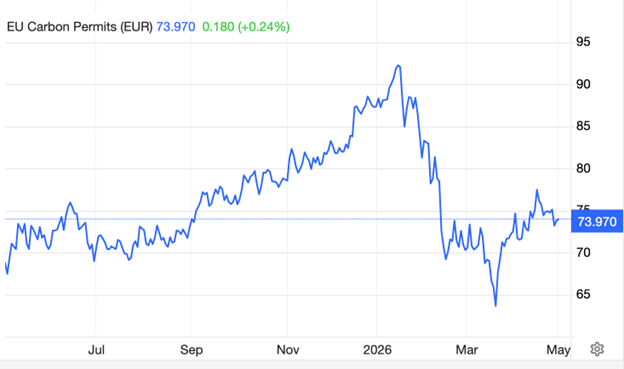
At the same time, structural tensions within the EU ETS are becoming more visible ahead of the upcoming system review. Industry competitiveness concerns are increasingly shaping the debate, particularly around carbon leakage, the role of free allowances, and the interaction with CBAM. Calls to maintain a stable and predictable carbon price signal coexist with demands for greater flexibility, including slower phase-outs of free allocation and enhanced market safeguards. Beyond institutional discussions, political fragmentation across member states is deepening, with some advocating for suspension or major revisions of the system, while others defend it as a cornerstone of EU climate policy. This divergence, driven by differences in energy mix, industrial structure, and exposure to carbon costs, is contributing to heightened price volatility and reinforcing uncertainty in the EUA market as stakeholders position themselves ahead of the next phase of reform.
Maritime & Shipping Updates
Demand for Low-Carbon Shipping Has Fallen, but Long-Term Value Persists
Peter Jameson, Dave Sivaprasad, David Schaar, Laurids Schack, Daniel Cáceres Larsen, Lasse Busch, and Katherine Cote, BCG
EU prepares to clash with US again over shipping carbon levy
Kate Abnett and Jonathan Saul, Reuters
INSIGHT: As Shipping Watches Strait of Hormuz, UK ETS Draws Closer
Philippos Ioulianou, Ship and Bunker
Ship Operators Face Rising Compliance Pressure
Ocean News & Technology
Recent developments show growing pressure on the maritime sector as decarbonization ambitions confront weakening commercial signals. Demand for low-carbon shipping is softening, with cargo owners’ willingness to pay premiums declining significantly amid regulatory uncertainty, geopolitical instability, and tighter economic conditions. This shift is compounded by delays in global regulatory frameworks, particularly at the International Maritime Organization (IMO), where efforts to introduce a global carbon price continue to face resistance and geopolitical friction, notably between the EU and the United States. While Europe remains committed to advancing international carbon pricing mechanisms, the lack of consensus at the global level is reinforcing uncertainty and slowing the pace of investment decisions across the sector.
Meanwhile, operational and regulatory complexity is increasing for shipowners, as overlapping frameworks such as EU ETS, FuelEU Maritime, and IMO requirements begin to directly affect fleet economics and day-to-day operations. Compliance is evolving from a reporting obligation into a core operational challenge, requiring integrated management of fuel consumption, emissions, routing, and performance data. In parallel, broader market conditions, including geopolitical tensions affecting key shipping routes such as the Strait of Hormuz, are adding further volatility to cost structures and trade flows. Despite these headwinds, long-term decarbonization trends remain intact, with continued investment in efficiency technologies and alternative fuels, suggesting that while near-term demand is becoming more selective, the structural transition of the sector is still progressing.
EU CBAM Updates
EU regulation spurring a wave of green alternative cement producers, analysis shows
Carbon Pulse
CBAM extension debate heats up as VDMA rejects policy
Benjamin Steven, Eurometal
CBAM risks reversing market integration
Emese Fabian, Ceenergy News
CBAM data for Q1 2026: Historic power flow patterns between EU, Western Balkans shift
Balkan Green Energy News
EU carbon border policy is beginning to reshape industrial dynamics, while simultaneously triggering growing resistance from affected sectors. On the one hand, CBAM-linked regulation is accelerating structural change in carbon-intensive industries, with early signs of increased investment in lower-carbon production pathways, particularly in sectors such as cement. On the other hand, industrial stakeholders are raising strong concerns over the mechanism’s practical implementation, especially as discussions intensify around extending CBAM to downstream products. Industry groups indicate significant administrative burdens, limited access to reliable emissions data from third-country suppliers, and the risk of inflated compliance costs driven by default values. These frictions are fuelling calls for either fundamental revisions or even the abolition of the mechanism, while also exposing unresolved tensions around competitiveness, carbon leakage, and the treatment of exports.
At the same time, early operational evidence suggests that CBAM is already influencing market behaviour beyond industrial goods, particularly in electricity trade. The introduction of carbon costs on imports has altered cross-border dynamics, reducing trading volumes and widening price differentials between EU markets and neighbouring regions. Uniform application of default emission factors, including to renewable electricity, is creating distortions by limiting arbitrage opportunities and constraining flows from lower-cost producers. These developments point to a risk of weakening market integration and increasing system inefficiencies, while also raising concerns around operational security and network stability. Although ongoing discussions on CBAM adjustments aim to address some of these issues, the initial phase of implementation shows the complexity of aligning carbon pricing with trade flows without generating unintended economic and market consequences.
Voluntary Carbon Market News
Carbon credits have enabled vital protection of tropical forests—despite being oversold 10-fold
University of Cambridge
Carbon market dynamics in 2026 – six data-based takeaways on today’s VCM
Rey Esmaielbeiki, Adatable
What’s next for carbon markets? Maturity signals or ‘medieval indulgences’
Jennifer Marston, AFN
How to navigate all those certifications in the voluntary carbon market
Jim Giles, Trellis
The voluntary carbon market continues to face a dual narrative of environmental relevance and credibility challenges. Recent research shows that, despite widespread concerns around over-crediting, many REDD+ forest projects have delivered tangible climate benefits, with a majority effectively reducing deforestation. However, the issuance of carbon credits has significantly exceeded actual impact, in some cases by nearly an order of magnitude, contributing to a sharp loss of market confidence and a decline in overall market value. This reinforces the need for stricter methodologies, improved baselines, and more rigorous verification frameworks, with a growing consensus that fewer, higher-quality credits issued at higher prices could restore integrity without undermining the role of carbon finance in protecting critical ecosystems.
At the same time, broader market dynamics point to a gradual structural evolution rather than collapse. While the VCM remains oversupplied, with issuance consistently exceeding retirements, demand has stabilized in recent years, albeit with increased volatility and seasonal patterns. Buyers are shifting toward newer, higher-integrity credits, while transparency is improving as disclosure practices strengthen and the buyer base becomes more diversified. Nonetheless, persistent concerns around credit quality, additionality, and verification continue to weigh on corporate participation, as illustrated by cautious procurement strategies and high-profile adjustments from major buyers. In response, the market is increasingly moving toward stricter standards, layered certification frameworks, and alternative approaches such as insetting, signaling a transition from a volume-driven market to one focused on credibility, traceability, and measurable impact.