
U.S. grain markets softened as harvest progress, paused government reporting, and global competition—especially from the Black Sea and Brazil—outweighed supportive factors like ethanol demand and soybean crush strength.
Wheat
December futures nearly -14% YTD, demand flattens
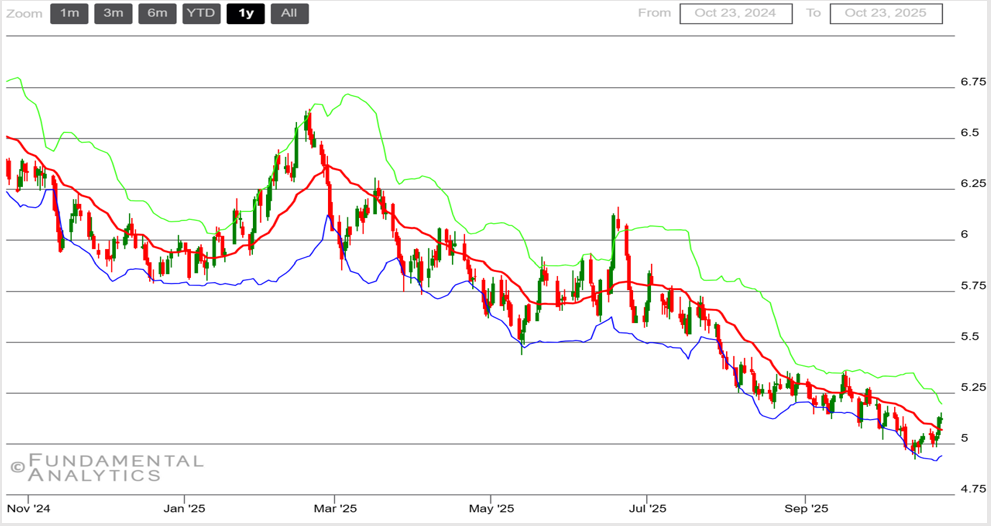
- Data pause kept U.S. supply perceptions heavy. With official Export Sales and Crop Progress paused due to the U.S. government shutdown, traders leaned on private estimates (winter-wheat planting ~75%) while September reports still loomed large: all-wheat output ~1.98B bushels and Sept-1 stocks 2.12B bushels (+6% y/y) gave a soft backdrop for December CBOT.
- Black Sea pricing remained the key headwind. Moscow cut its floating export duty, and market reports pointed to exports re-accelerating after a slow start—signals of aggressive offers that continued to cap Chicago rallies.
- Import demand skewed toward Europe. Egypt’s state buyer and private firms added French and other EU/Black Sea cargoes, reinforcing non-U.S. dominance in Near East tenders and tempering any U.S. basis or spread strength.
- Southern Hemisphere supply prospects improved. Australia’s outlook lifted toward near-record levels as Western Australia’s harvest began and analysts nudged national estimates higher, foreshadowing additional export competition into Q4 and pressuring deferred CBOT pricing.
Corn
Front month Corn futures decreased more than 5% during 2025, exports remain weak
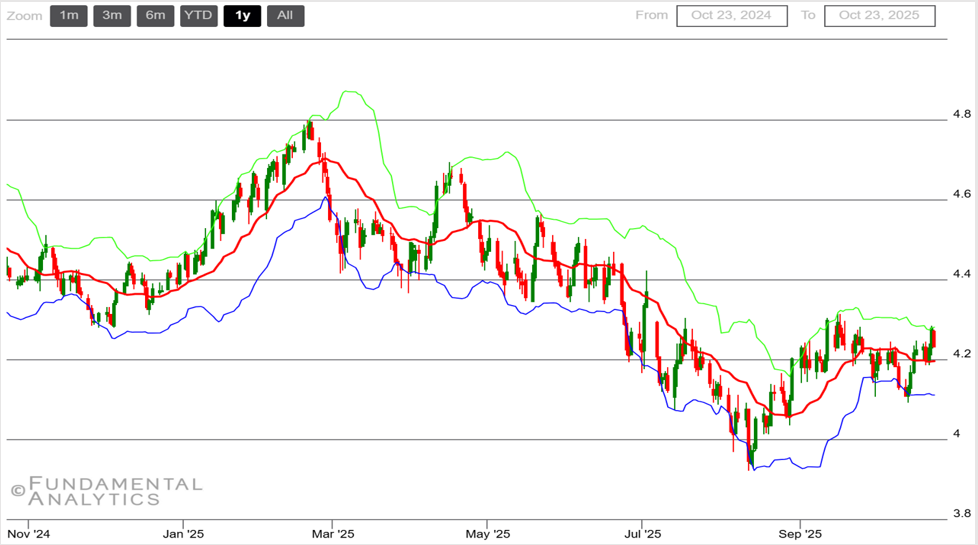
- Harvest advanced under a data blackout, reinforcing a heavy supply tone. With USDA’s Crop Progress and Export Sales paused, private surveys pegged U.S. corn harvest near the upper-50s percent—enough momentum to limit weather-risk premia in December futures.
- Export visibility stayed murky while Brazil undercut offers. The reporting pause clouded near-term demand reads; meanwhile, Brazil’s shippers guided October corn exports around 5.8–6.3 MMT, keeping FOB Santos competitive versus the U.S. Gulf despite prior U.S. sales to Mexico.
- River logistics constrained Gulf competitiveness. Persistently low Mississippi/Ohio levels lifted barge costs and restricted drafts, softening CIF basis and muting export arbitrage just as new-crop supplies were hitting the pipeline.
- Ethanol metrics offered only modest support. Mid-October EIA data showed plant output rising toward ~1.11 million bushels/day with inventories edging down; record-pace ethanol exports year-to-date helped at the margin but didn’t alter the broader bearish backdrop.
Soybeans
Jan’ 26 contracts managed to modestly outperform (+2.3%) since the start of 2025
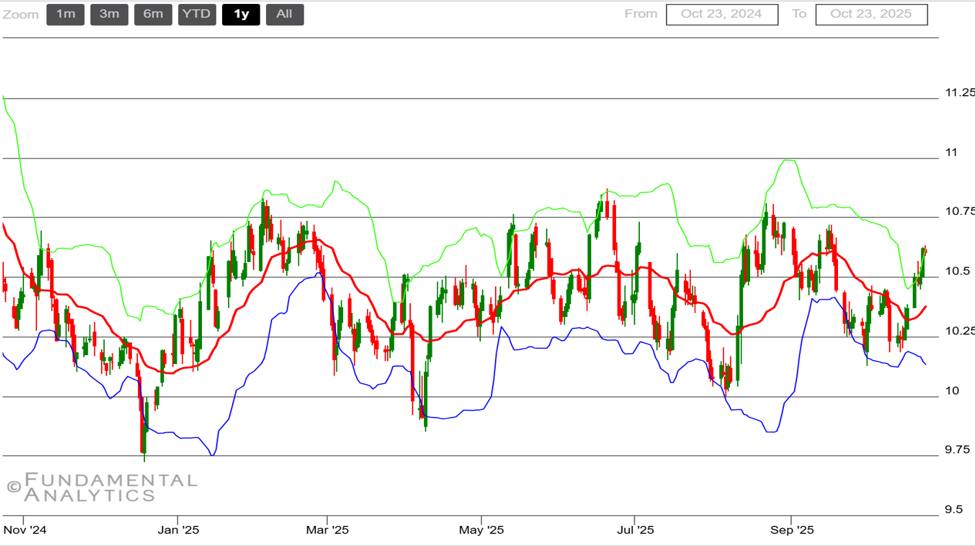
- U.S. harvest pace and the data void kept a lid on risk premia. With official reports paused, private surveys pegged soybean harvest around the low-to-mid-70s percent, reinforcing a broadly comfortable domestic supply backdrop for Jan ’26.
- Record-strong crush offered support—but not a trend change. NOPA’s September run surged to ~198M bushels, a new monthly record, underpinning meal/oil demand even as futures struggled amid export headwinds.
- Export competitiveness favored Brazil as China sidelined U.S. beans. China reportedly took zero U.S. cargoes in September while ANEC projections pointed to sizeable October Brazilian shipments, keeping FOB Paranaguá under U.S. Gulf and weighing on Chicago spreads.
- South American planting signals were mixed, adding two-way risk. Reports flagged early-October dryness in Mato Grosso even as central Brazil sowing accelerated after showers; structurally, China’s soymeal-reduction policy remains a longer-run demand headwind.