
Welcome to the latest edition of the Carbon Market News Roundup, our monthly briefing on the evolving landscape of global carbon markets and climate-related regulation. Our previous issues, along with the rest of our commentaries, may be read here.
In this issue, we explore how the European carbon market is entering a phase of recalibration, where upcoming adjustments to free allocation benchmarks, evolving Market Stability Reserve mechanisms, and sustained emissions reductions are shaping both price dynamics and industrial expectations. At the same time, the maritime sector reflects a growing intersection between regulation and geopolitics, as early emissions data signal the first effects of ETS inclusion while international tensions at the IMO and rising fuel costs accelerate the push toward efficiency and technological adoption. In parallel, CBAM continues to move from design to implementation, with clearer pricing signals and increasing scrutiny from trading partners highlighting both its role as a tool for global policy alignment and the operational challenges it creates for exporters. Meanwhile, the voluntary carbon market is navigating a transition toward greater structure and credibility, where shifting corporate demand, tighter accounting standards, and ongoing integrity debates are reshaping market participation and reinforcing the gradual evolution toward a more mature, but still constrained, ecosystem.
EU ETS – Regulations Updates
The EC will propose updated benchmarks for the free allocation of allowances in the ETS
Halina Yermolenko, GMK Center
EU Emissions Trading System sustains downward trend in covered emissions
European Commission
European carbon prices remain above €70/t in April
Halina Yermolenko, GMK Center
EU fertilizer industry warns of CBAM, ETS risks to food security, market shows caution
Chris Vlachopoulos, ICIS
The European Commission is preparing a new phase of EU ETS adjustments, with updated benchmarks for the free allocation of allowances expected to define industrial distribution between 2026 and 2030. Early indications suggest the revisions will broadly align with previous expectations, while introducing targeted adjustments that could benefit specific subsectors such as refined petroleum products and E-PVC. In parallel, the Commission has proposed changes to the Market Stability Reserve (MSR), notably suspending the automatic cancellation of allowances above the 400 million threshold to retain them as a strategic buffer, reinforcing the system’s capacity to respond to future supply shocks. These developments come alongside continued structural progress in emissions reduction, with verified 2025 data showing a further -1.3% decline in ETS emissions, driven by ongoing decarbonization in power generation and industry, including a 2.5% drop in energy-intensive sectors and sustained growth in renewable electricity, particularly solar.
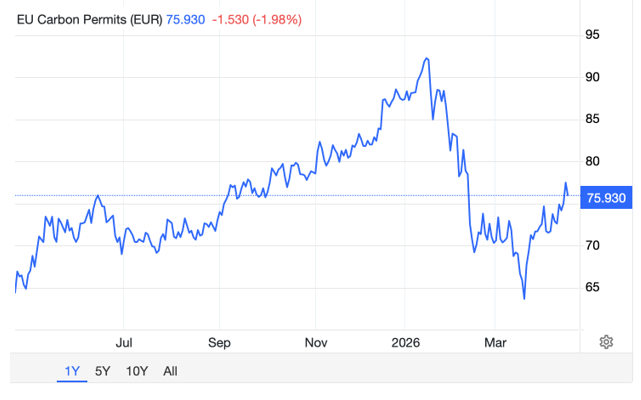
Carbon market dynamics in early April reflected a combination of policy signals and geopolitical uncertainty. EUA futures remained resilient above €70/t, reaching a seven-week high of €74.6/t following the announcement of measured MSR reforms, which reassured market participants by avoiding aggressive intervention. Prices stabilized in the €71–72/t range after the Easter period as trading volumes remained subdued and attention shifted to external risks, particularly tensions in the Middle East. At the same time, the European Commission set the first CBAM certificate reference price at €75.36/t, closely aligned with EUA auction averages, providing an initial benchmark for import-related carbon costs. Against this backdrop, industrial stakeholders in the fertilizer sector have raised concerns over persistently high carbon and energy costs, warning of competitiveness pressures and calling for a temporary freeze in ETS obligations, although views remain divided on the feasibility of such policy adjustments.
Maritime & Shipping Updates
EU ETS data shows shipping emissions fell 3% in 2025
Safety4Seas
US Calls for Mandatory Phase-out of EU ETS in Formal IMO Submission
Ship & Bunker
South Korea Unites Industry to push IMO standard for ship carbon capture
Hellenic Shipping News
Sky-high fuel prices will drive ship efficiency retrofits
Paul Bartlett, Sea Trade Maritime
Early EU ETS data point to a meaningful reduction in maritime emissions, with shipping emissions declining by around 3% in 2025, contributing to the broader downward trend observed across the system. While the sector’s integration into the ETS is still recent and reporting remains ongoing, the initial figures suggest that regulatory inclusion is beginning to influence operational behavior. At the same time, the international dimension of maritime decarbonization is becoming more contested, as the United States has formally called at the IMO for a rollback of the EU ETS application to shipping, showing growing tensions between regional and global regulatory approaches. In parallel, South Korea is mobilizing industry stakeholders to promote international standards for ship-based carbon capture, signaling increasing momentum behind technological solutions as countries position themselves in shaping future IMO frameworks.
Geopolitical developments are adding a new layer of urgency to the sector’s transition. Escalating tensions in the Middle East have significantly disrupted fuel supply chains and driven a sharp increase in bunker prices, creating strong economic incentives for shipowners to accelerate efficiency improvements and retrofit programmes. Higher fuel costs are shortening payback periods for a wide range of technologies, from wind-assisted propulsion to digital optimization systems, making decarbonization investments more financially attractive. As a result, market dynamics are increasingly aligning with sustainability objectives, with operators reassessing fleet strategies and engaging more closely with charterers and cargo owners, particularly as Scope 3 emissions considerations continue to shape demand across global shipping value chains.
EU CBAM Updates
Carbon Pulse
Eurometal
European Commission provides critical CBAM cost component
Adam Smith, Eurometal
Brussels confirms first CBAM certificate price for Q1 2026 at Eur75.36/mtCO2e
Eklavya Gupte, S&P Global
Early evidence suggests that the global impact of CBAM will vary significantly depending on domestic climate policies, with Asian economies that implement effective carbon pricing expected to face more limited exposure to the mechanism. This shows CBAM’s role not only as a trade measure but as an incentive for policy convergence, encouraging third countries to align with carbon pricing frameworks comparable to the EU ETS. Meanwhile, concerns are emerging among key exporting industries regarding the practical application of the mechanism. The Turkish iron and steel sector has raised strong objections to the use of default emission values, arguing that they fail to reflect its relatively low-carbon, electric arc furnace-based production structure, thereby creating distortions in competitiveness and potentially overstating carbon liabilities for exporters.
Operational clarity is gradually improving with the publication of the first CBAM certificate price for Q1 2026 at €75.36/tCO₂, directly linked to EU ETS auction averages and providing a concrete benchmark for calculating import-related carbon costs. This development allows importers to more accurately assess financial exposure, while also showing the significant cost differences between default and verified emissions data. However, market signals indicate that carbon pricing dynamics remain sensitive to political and economic pressures, as EUA prices have softened in recent months amid calls to ease the ETS burden on industry. While CBAM’s pricing framework enhances transparency and alignment with the EU carbon market, it also reinforces the mechanism’s financial implications for global trade, with implementation details such as verification processes, pricing frequency from 2027, and platform infrastructure continuing to shape how effectively and equitably the system will operate.
Voluntary Carbon Market News
Microsoft Reaffirms Commitment To Carbon Removal Strategy
Vasil Velev, Carbon Herald
UN-Backed Forest Carbon Program May Reward The Wrong Countries, Study Finds
Theodora Stankova, Carbon Herald
Climate reporting rules for food sector set high bar for regenerative agriculture
Mark Hillsdon, Reuters
Carbon Pulse
Recent developments show both the central role of corporate demand and the evolving structure of carbon removal markets. Microsoft moved to reaffirm its long-term commitment to carbon removal, clarifying that while procurement volumes may fluctuate, its strategy remains unchanged and continues to support both nature-based and engineered solutions. The announcement comes after market concerns over a potential slowdown, underlining the outsized influence of large buyers on market sentiment. Evidence suggests that demand is gradually diversifying, with non-Microsoft buyers increasingly contributing to total contracted volumes and delivery rates, pointing to a broader base of participation. However, questions around environmental integrity persist, as new research on jurisdictional REDD+ programmes indicates that current baseline methodologies may reward regions already reducing deforestation while failing to incentivize those facing rising forest loss, raising concerns over the effectiveness of large-scale forest crediting mechanisms.
At the structural level, efforts to improve credibility and standardization are reshaping how carbon credits are measured and used. The introduction of the Greenhouse Gas Protocol’s new Land Sector and Removals Standard establishes stricter rules for accounting and reporting land-based emissions and removals, increasing transparency but also raising the bar for project viability and potentially reducing the volume of credits that can be credibly claimed. In parallel, market behavior is evolving as corporates increasingly turn to multi-year offtake agreements and adopt more selective procurement strategies, particularly for high-quality removal credits. This shift reflects a broader transition toward a more mature market structure, where long-term commitments, stronger verification requirements, and tighter supply conditions are gradually replacing earlier, less standardized approaches.