
Dr. Ken Rietz
The prices of soybean futures have been going up, but much of the data has been neutral to bearish. If price is king, the peasants are restless. Which one should we follow? In this week’s commentary, we look at the fundamentals and the price, and try to reconcile the two, and end up with a reasonable trading strategy for soybean futures. But first, we look at what the soybean front-month futures are doing.
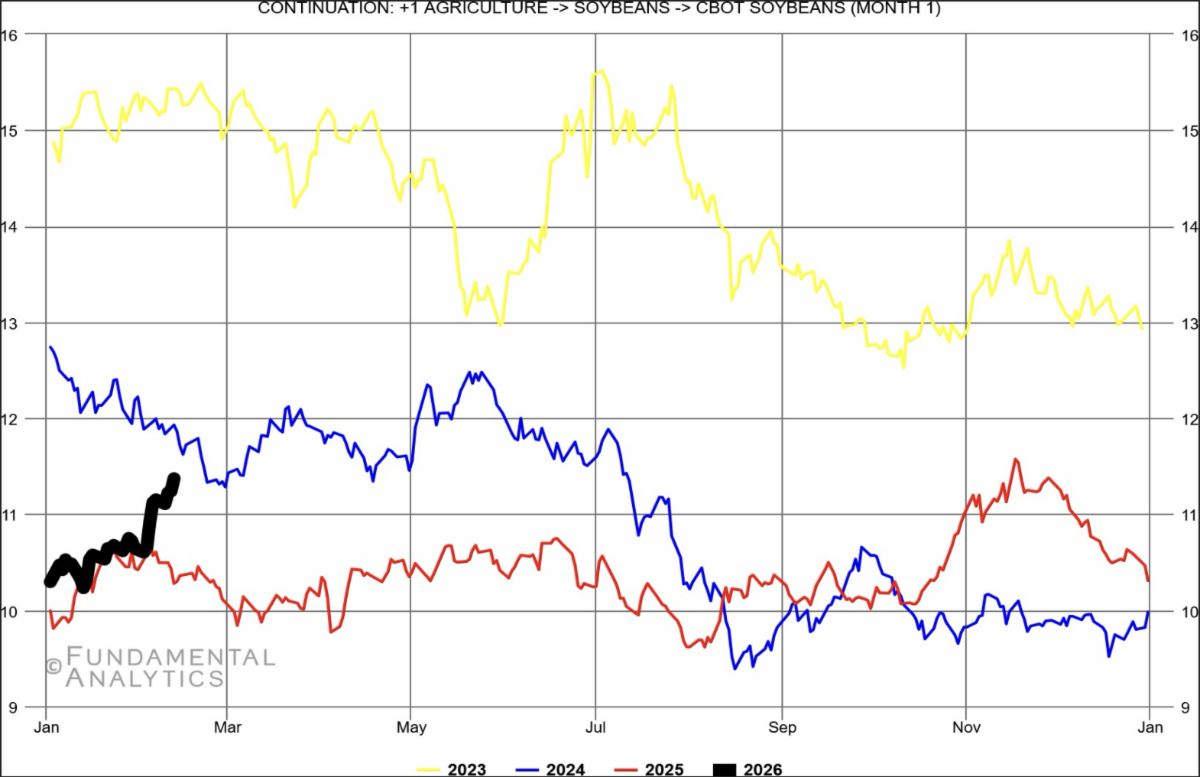
The futures price of soybeans is clearly on a sharp upward trajectory. Most of the data on soybeans, however, is more neutral, as we shall see. The question is how much can we trust the price action to continue increasing, or will the data pull the price back down?
Let’s look first at some of the factors that often affect the price of soybeans, and see if there is any reason that they affect the futures price now.
- Weather: The brutally cold weather in North America and Europe should have little effect on soybeans, which won’t be planted for several weeks to months. There is a 50–60% chance of a moderate El Niño for the fall of 2026, which would bring warmer and wetter weather to North America, but it might not be enough to make any difference.
- WASDE: Agweek.com analyzed the WASDE data and found that there was little change in stock values, at 350 million bushels, and no solid prospects for extra export (China, for example) in the near future. Nor is there any movement on the 45Z biofuel front that would cause crushing soybeans to get oil to diminish soybean stocks. Since China’s attempt at growing GMO soybeans is not going well, there is a chance for more exports to there.
- South American soybeans: CONAB now projects a record high crop of Brazilian soybeans this year. This would normally be a strong bearish signal for US soybeans, completely contrary to what has been happening. And for the 2026–27 year, CONAB estimates a slightly higher harvest also.
All of these are factors that are neutral to bearish for the price of soybean futures, but the actual price doesn’t reflect it. There is, however, another factor that doesn’t depend on data: expectations. If the market expects that China will buy more soybeans, or that the weather will seriously degrade the soybean crop, then the price will shoot up, and that is what we see now. It isn’t the market pricing in a higher usage of soybeans, but rather a collective anticipation of some such movement.
So, how do you trade an anticipation? This is tricky, but because of the surge upward in futures prices of soybeans, it would be prudent to assume that it will continue for a while. However, there is every chance that the soybean market will reverse rapidly if none of the expected moves actually happen. Smaller-than-usual trade sizes upward, together with a careful watch for reversals, would be reasonable right now.